

AANDELE PRYSE IN SA EN VSA EN DIE OORLOG IN DIE MIDDE-OOSTE

Dr. Riaan Botha • May 6, 2026

Agtergrond

Geopolitieke spanninge het daartoe gelei dat oorlog tussen Amerika/Israel en Iran op 28 Februarie 2026 uitgebreek het. Een van die gevolge van die huidige oorlog is die verminderde olieproduksie en die gevolglike styging in brandstofpryse. Die duurder brandstof raak nie net Suid-Afrikaners se sak wanneer hulle hul motors se tenks vul nie, maar beïnvloed ook die winsgewendheid van Suid-Afrikaanse maatskappye wat op die Johannesburgse Aandelebeurs (JSE) genoteer is.


Suid-Afrika

Suid-Afrika vorm deel van die ontwikkelende ekonomieë wat aanvanklik goed gevaar het gedurende die eerste twee maande van 2026, totdat die oorlog op 28 Februarie uitgebreek het. Gedurende Maart 2026 het die JSE All Share Index met 13% gedaal — die grootste maandelikse daling in 18 jaar. Gedurende April het die indeks egter gestabiliseer, maar dit bly sensitief vir energieprysskokke.


Weens die hoër brandstofpryse het Suid-Afrikaanse industriële aandele, kleinhandelaars en eiendomsmaatskappye se aandeelpryse gedaal. Hierdie ondernemings is nou gekoppel aan die plaaslike ekonomie en verbruikersbesteding, wat tans onder druk verkeer. Groot maatskappye met internasionale blootstelling se pryse het ook verswak. Richemont is geraak deur swakker wêreldwye vraag na luukse goedere, terwyl Naspers en Prosus afgetrek is deur swakker prestasie in Chinese tegnologie-aandele.


Die Suid-Afrikaanse geldeenheid het ook ’n belangrike rol gespeel. Die rand het versterk tot ongeveer R16 teenoor die Amerikaanse dollar voordat dit effens verswak het. Hoewel dit positief mag klink, verminder ’n sterker rand die waarde van buitelandse verdienste wanneer dit terug na rand omgeskakel word. Aangesien baie van die grootste maatskappye op die JSE hul inkomste oorsee verdien, het dit hul aandeelpryse verder gedemp.


Amerika

Amerika vorm deel van die ontwikkelde ekonomieë, en hul aandelebeurse is anders deur die oorlog geraak. Suid-Afrikaanse aandele het nie tred gehou met die sterk herstel van die Amerikaanse markte ná die aanvanklike daling in aandeelpryse aan die begin van die oorlog nie. Dit was die gevolg van ’n kombinasie van wêreldwye onsekerheid, die tipe maatskappye wat op elke mark genoteer is, en bewegings in wisselkoerse.


Amerikaanse maatskappye, veral in die tegnologiesektor, het voortgegaan om winsgroei te toon, wat beleggers gelok het. In onseker tye neig internasionale beleggers ook om geld na die VSA te verskuif omdat dit as ’n veiliger beleggingsbestemming beskou word. Suid-Afrika, aan die ander kant, het ’n mark wat meer afhanklik is van kommoditeite en wêreldwye ekonomiese siklusse, wat dit meer vatbaar maak vir skokke.


Samevatting

Daar is ’n gesegde: “Dit is makliker om ’n oorlog te begin as om dit te stop.” Mag diplomate die oorhand kry oor generaals sodat vrede kan terugkeer. Vrede sal olieproduksie verhoog en gevolglik brandstof goedkoper maak. Dit gaan egter tyd neem voordat die huidige hoë brandstofpryse en inflasiedruk verdwyn.


In ’n ná-oorlogse situasie kan verwag word dat die JSE weer sterk sal vertoon, mits inflasie onder beheer bly en rentekoerse nie dramaties verhoog word nie.


NOTA

Ek het in 1983 my meestersgraadverhandeling in Staatsleer aan die Universiteit van die Vrystaat voltooi met die titel: “Islamitiese Determinante in die Wêreldpolitiek.”


Dit is kenmerkend dat die rol van olie in die internasionale politiek gedurende 1970’s, weer 50 jaar later herhaal word. Die prys van ’n vat olie het destyds van 1,80 dollar in 1970 na 3 dollar in 1973 en na 31 dollar in 1979 gestyg. Daar was bewindsverandering in Iran toe die Islamietiese Revolusie in 1979 plaasgevind het. Iran, wat deel van OPEC is, het destyds ook olie aangewend om sy Islamitiese doktrine internasionaal te bevorder.


In die huidige oorlog word olie steeds deur Iran as ’n geopolitieke wapen gebruik om Amerika en ander olie-verbruikende lande onder druk te plaas.


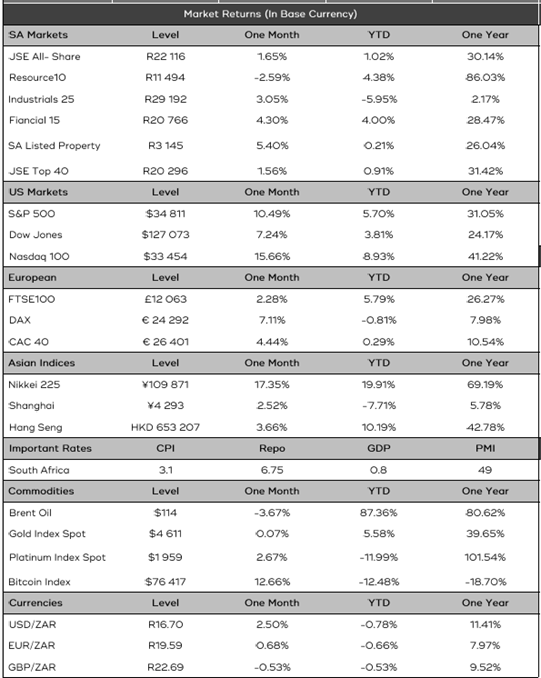
Marksyfers tot einde April 2026
By Ruvan J Grobler May 5, 2026
You can build significant wealth and still leave your family with a mess. Not because you didn’t plan—but because your cash wasn’t structured correctly. Too much liquidity in the wrong place, fragmented accounts, or misaligned ownership can quietly undermine even the most carefully drafted estate plan. Without intention, even a well-built estate can become complicated, delayed, or unnecessarily taxed. Estate planning isn’t just about documents and wills. It’s about how your money actually flows—and whether that flow supports or disrupts the legacy you intend to leave. Where do Money Market/Fixed Deposits/Savings Accounts fit into your portfolio? Financial Planning Cashflow These short-term conservatively positioned assets, just like all conventional asset classes, have a specific place in financial planning. It can be aligned with short-term investment goals where liquidity is key and can also form part of emergency savings. It’s important to note that interest earnings are taxed as income and can create unexpected tax liabilities. Risk Aversion Not all investors feel the same about risk, and that’s ok. Some might argue the price of holding cash in the long-term, but the investor has peace of mind that there will never be any surprises when opening investment statements, although it may come at the price of inflation beating growth over the long term. Implications on death by not holding the cash investment in a structure: Tax: The capital will form part of the dutiable estate for purposes of calculating the estate duty payable to SARS. 20% levied on dutiable estate between R3.5 million and R30 million, 25% levied on dutiable estate exceeding R30 million. Executor’s fees: The capital will form part of the calculation of executor’s fees charged by the executor of the estate. 4% (Incl. VAT) is the general fee charged by executors. Liquidity: In normal circumstances, the capital will only be available to beneficiaries once the Master of the High Court has accepted the L&D account and there is sufficient liquidity to make distributions. How do we solve this? It’s important to make sure that if you hold cash investments that it not only follows your financial planning goals, but the structure is considered too. Wrapping the assets in a structure solves two of the above issues, no executor’s fees can be charged if a cash investment moves directly from the deceased to the beneficiary via a nomination, and this process also provides liquidity to beneficiaries significantly faster than if it formed part of the estate for distribution purposes. Some structures may have liquidity constraints before death making it important to consider multiple structures to make sure your financial planning goals can be funded. Another major benefit of a wrapped structure is the deferral of tax liability as the structure will be taxed and not the individual. This income tax liability is taxed at a flat 30% and paid to SARS by the product provider. It may also be a good idea to look at who actually owns the cash investment. Moving it to your business or trust can also come with positive estate planning fundamentals. Reach out to me at ruvan@bovest.co.za to look at estate planning friendly structures for your cash investments. Ruvan J Grobler RFP™ (PGDip Financial Planning)
By Francois le Clus May 4, 2026
Whether we like it or not, we are emotionally attached to our finances, especially our investments. I understand this because I also fall into this trap, even though I’m a financial professional. March was not a fun month for me or just about any investor in the world. We saw significant downward movements in markets across the globe, and there was nowhere to hide except cash. It also didn’t help that I checked regularly on my portfolio’s performance. I was shocked, even though I knew it was bad, but I found solace in the fact that markets will recover again, and this was short-term. The funny thing was that my portfolio was still up year-to-date, and I was still up, but I anchored the investment value and saw the past month’s investment performance as a loss, but I was still in the money. I fell into two traps. I anchored a number, and I had given in to myopic loss aversion. What Myopic loss aversion? Simply put, Investors feel losses more strongly than gains (loss aversion). This led me to experience anxiety and consider making a change to my portfolio’s. (Luckily I didn’t). This led my into doing some more research into markets and how they behave on a daily, monthly, quarterly, and yearly basis. I was quite shocked by the data and how I could potentially sabotage my portfolio. When looking at the S&P 500 and the JSE, you can see data that is very closely correlated with each other. When looking at the daily performance of the indices over the past 15 years, you would see that the S&P 500 had positive 53% of trading days and negative 47%. When looking at the JSE on a daily basis, you would see 51% to 53% positive days and 47% to 49% negative days. Even in strong bull markets, almost half of all days are negative. Returns are driven by a relatively small number of strong up days. When looking at monthly performance, the S&P had 60%–65% positive months vs 35%-40% negative months. The JSE had 56% positive months vs 44% negative months. You can already start to see how the data is moving in a more positive direction. When looking at quarterly performance, the picture becomes even better. The S&P delivered Positive quarters between 65%–70% and negative quarters between 30%-35%. When looking at the JSE, it delivered positive quarters between 55%–65% and negative quarters between 35%-40%. When looking at the yearly performance, the S&P delivered 75%-80% positive months vs 25%-30% negative returns. The JSE delivered 60%-70% positive years vs 40%-30% negative years. Losses at the yearly level are relatively infrequent but can be sharp. The pattern becomes very clear: The longer the timeframe, the higher the probability of a positive return. Short-term volatility is normal and persistent. Long-term returns are driven by compounding and upward drift. Practical interpretation (important) Volatility is constant. Even in strong years, many days and months are negative. This is why timing the market is extremely difficult. Time horizon is everything - Daily investing feels like a coin flip. - Long-term investing becomes probability in your favour. Best days matter disproportionately Missing a handful of strong positive days can materially reduce returns. Side-by-side summary