

Hedge funds are not only for high-risk investors

Bovest Admin • October 19, 2026

Often, when people hear about hedge funds, they tend to think of high risk, fast trading, big bets and wealthy investors chasing huge returns.


But the word ‘hedge’ actually means to protect or cushion.


Some hedge funds are aggressive. Others are designed to help soften the blow when markets fall. That is why hedge funds are not only for risk-tolerant investors.


At Bovest, we believe no type of investment is automatically good or bad. The important question is: What role could this investment play in a bigger financial plan?


What is a hedge fund?

A hedge fund is a pool of money collected from investors. The hedge fund is then actively managed by investment professionals who use advanced techniques to maximise returns.
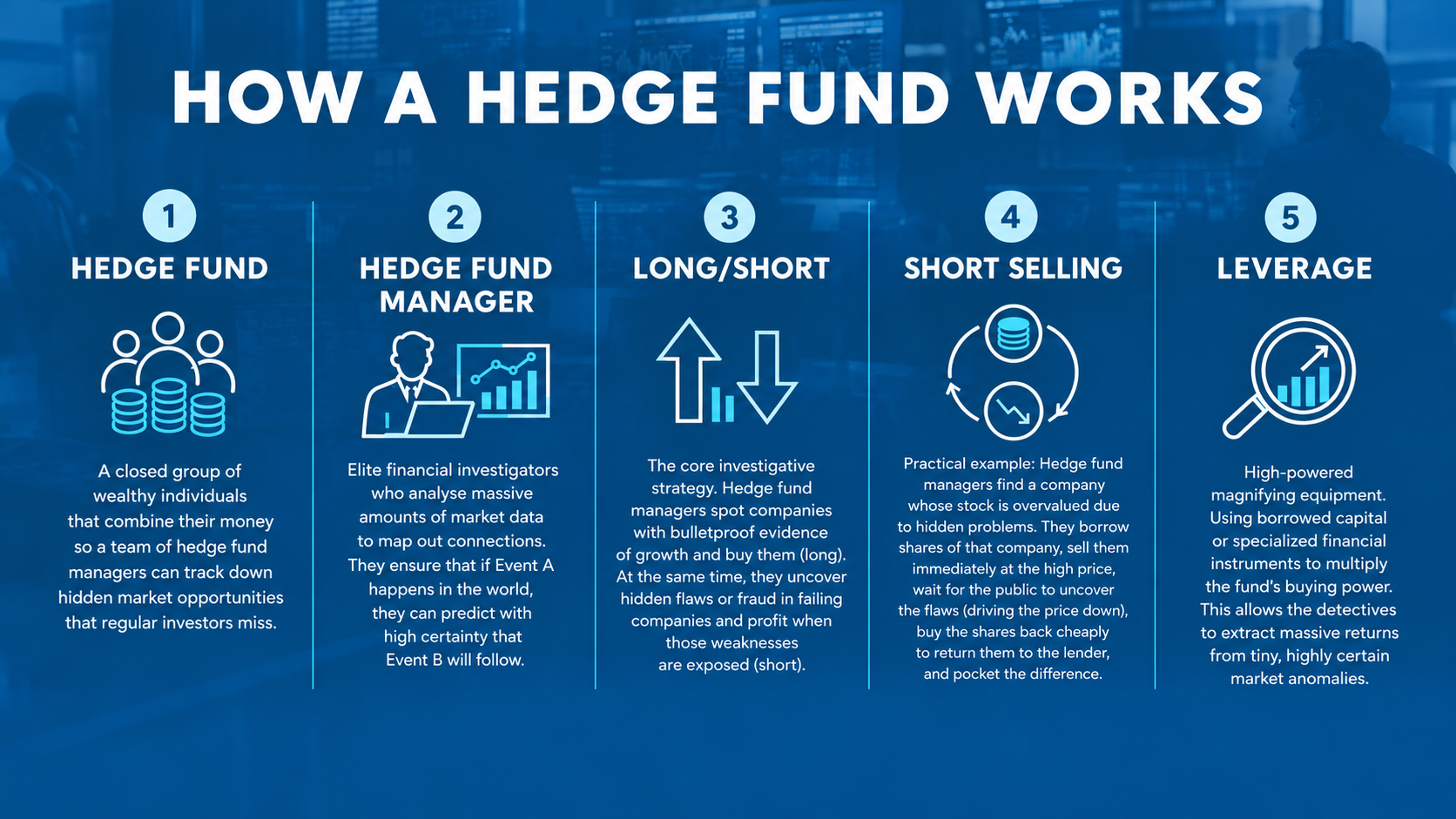
What is a hedge fund manager?

Think of a hedge fund manager as a forensic financial detective. Instead of only watching the main market headlines, they dig deeper. Much deeper. They research companies, study economic news and dissect market patterns to find opportunities or gaps that others may miss.


A normal investment fund usually makes money when markets go up. A hedge fund manager may also look for ways to manage risk, or find opportunities, when markets go down or move sideways.


But hedge funds can still lose money. They are not safe just because they are called hedge funds. But they are not automatically reckless either. Let’s unpack this point in a bit more detail, using the metaphor of the two farmers.


Hedge funds explained: the farmer analogy

Picture your money as a farm.


A traditional investor is like a farmer who plants one type of crop and hopes for good conditions. If there is a drought, a flood, or a bad harvest, the whole farm suffers.


Now, a hedge fund manager thinks more like a farmer who prepares for different seasons. They may plant different crops, not just one. They may get insurance against drought or buy water for emergencies. They may even sell a future harvest in advance to assist with cash flow. And they will typically keep a keen eye on developments on nearby farms for opportunities.


None of this means that this farmer will never have a bad year. But it gives them more than one way to handle a difficult season.


The role of hedge funds in a balanced investment portfolio

A well-structured wealth plan functions like a balanced team: every investment type has a specific role to play.


If global equities serve as your primary growth engine and fixed income provides stability and liquidity, a conservative retail hedge fund can serve as the portfolio’s shock absorber.


The fundamental idea behind portfolio diversification is balance. Essentially, a well-diversified portfolio aims to participate in a strong portion of market growth while cushioning the impact of market drops. Because different investment types react differently to economic conditions, combining them creates a smoother overall return profile over time.


Under the Collective Investment Schemes Control Act (CISCA), regulated retail hedge funds in South Africa operate under strict oversight and risk limits. They are no longer limited to institutional investors and offer accessible minimum investment amounts for everyday investors.


Key takeaways: embrace strategy over financial complexity

Ultimately, we believe no investment should be viewed in isolation. What matters is how it fits into your broader financial plan and supports your long-term goals.


"The best way to create and grow wealth is to learn from those who have already reached their financial goals."

— Riaan Botha, author of Welvaartskeppers


At Bovest, we’ve built a team of specialists, each with their own area of expertise, giving our clients access to a wealth of knowledge and a single destination for all their investment needs.


Watch Season 2 of Welvaartskeppers on kykNET to get the inside scoop on some of the strategies used by top investment groups like Peregrine Capital and Amplify.


One conversation has the power to change a life. To set up a meeting with one of our experts, simply share your details here and we’ll be in touch — no obligation.


This article is general information and does not constitute financial, legal or tax advice. Speak to a qualified financial adviser about your own circumstances


By Bovest • October 15, 2026
Most of us spend years working out how to grow our wealth, and far less time asking what could put it at risk. We plan as though good health, stable markets and steady momentum will always hold. But wealth can look secure right up until the thing you never planned for happens. Think of how quickly things can change. A pandemic upends your industry. Technology makes your role obsolete. A market slump tempts you into an emotional decision that undoes years of discipline. Each of these begs a simple question: what happens to your wealth-building machine if one of its assumptions fails? Wealth protection vs income protection The two are closely linked, but they are not the same thing. Cover such as disability or severe illness insurance protects your earning power. Wealth protection looks at what that income has built, and what happens to it if you’re no longer around to manage it. "The financial history of the world shows that families have always played a central role in wealth creation." — Riaan Botha, author of Welvaartskeppers The wealth you build, and hope to leave to your children, rests on two things: your ability to earn, and your ability to protect the assets you’ve built. Illness, disability, a market downturn or an unexpected death can threaten both at once. Making money builds wealth. Protecting it helps you keep it for the people you built it for. What are the key forms of wealth protection? Here’s a look at four key forms of wealth protection, what they do and the role they can play: Insurance Replaces your income if something happens to you, so your family can meet their obligations and maintain their lifestyle. Your will Stipulates who receives what. A will only works if it is valid and can be found when it’s needed. Trusts Holds and manages assets for beneficiaries who can’t legally (or otherwise) manage them yet. Trusts can help structure your assets during your lifetime and beneficiaries may typically include minor children. It is important to note that trusts come with their owns costs, tax treatment and administration, so they work best when set up for a clear purpose, guided by professional advice. Estate planning Ensures that your estate has enough cash to settle what it owes without forcing a sale of your assets. Four questions to test your wealth protection plan Use the following questions as an initial reality check to see where your wealth protection plan stands, and where the gaps might be: Would your family have adequate financial support if something happened to you? Bond repayments, school fees and medical aid contributions keep coming whatever happens to your income. Check that your life, disability and severe illness cover is measured against your actual debts, your dependents and how long they would need support, and that it hasn’t gone stale since your circumstances changed. Are your beneficiaries up to date? Marriages, divorces, births and deaths all change who should benefit. Still, often nominations on policies and retirement funds are often set once and forgotten. When nominations and your will contradict each other, the result can be delays, disputes and money reaching the wrong person. Retirement fund trustees must also consider all your dependents, so your nomination guides them rather than binding them. Is your will valid, accessible, and structured correctly? A will must meet certain formalities, including the signatures of the testator and two competent witnesses. If the requirements aren't met, the will may not be accepted as valid, which could affect how the estate is distributed. It is also important that the executor can locate the original will. Where minor children are beneficiaries, a will can provide for a testamentary trust to hold their inheritance rather than it being paid into the Guardian's Fund. Will your estate have enough cash when you pass away? Before anything is distributed, an estate must pay executor's and Master's Office fees, debts, funeral costs, capital gains tax and, where applicable, estate duty. When wealth is tied up in property or a business, the executor may have to sell at the wrong time and the wrong price. Compare your liquid assets against likely costs and plan for any shortfall. Protecting your wealth: What’s next? If the four questions above exposed a gap, that’s a great place to start. Gaps are far easier to close while life is calm than having to rely on someone to sort things out on your behalf. Of course, you don’t need to fix everything at once. Start with the question that made you hesitate. Think of it as the foundation under everything else you’re building. Nobody admires it from the outside, but every decision about growing your wealth rests on it. "The key to successful wealth creation is knowledge. Only those who first learn to increase their income and then invest their surplus effectively as capital achieve long-term financial success.” — Riaan Botha, author of Welvaartskeppers There is no single miracle solution that guarantees success, but the principles behind it can be learned. Meet the South Africans who did it on Welvaartskeppers. One conversation has the power to change a life At Bovest, we believe money is ultimately a tool for buying something far more valuable: time. A sound financial plan gives you the structure, clarity and peace of mind to spend that time on the life you are building rather than worrying about it. Ready to build your life vision? Share your details and we’ll be in touch , no obligation. This article is general information and does not constitute financial, legal or tax advice. Speak to a qualified adviser about your own circumstances.
By Bovest • October 7, 2026
When most people start thinking about their financial future, they go straight to the products. Which index fund is performing best right now? Should I put money into a tax-free savings account or property? What about offshore tech stocks? Those questions feel natural. But they won’t necessarily get you where you want to go. This article explains why the financial products you choose matter far less than the plan they serve. Learn how to craft a clear, holistic financial plan — not just a well-diversified portfolio — and discover what really determines whether you build lasting wealth. The importance of a holistic financial plan Selecting quality investments matters. That said: choosing products without a broader blueprint is like buying building materials before you have drafted the architectural blueprint. Because in the end, it is not simply a matter of creating wealth for the short run, it is about creating wealth for life. At Bovest, our foundation rests on a simple principle: an investment portfolio is merely the engine, but a holistic financial plan is the GPS that directs you on your route. What are the 5 components of a financial plan A holistic financial plan does not start with market performance or product features. It begins with context. A comprehensive plan connects five distinct areas of your life into one cohesive strategy: