

Why a financial plan is more than an investment portfolio

When most people start thinking about their financial future, they go straight to the products. Which index fund is performing best right now? Should I put money into a tax-free savings account or property? What about offshore tech stocks?
Those questions feel natural. But they won’t necessarily get you where you want to go.
This article explains why the financial products you choose matter far less than the plan they serve. Learn how to craft a clear, holistic financial plan — not just a well-diversified portfolio — and discover what really determines whether you build lasting wealth.
The importance of a holistic financial plan
Selecting quality investments matters. That said: choosing products without a broader blueprint is like buying building materials before you have drafted the architectural blueprint. Because in the end, it is not simply a matter of creating wealth for the short run, it is about creating wealth for life.
At Bovest, our foundation rests on a simple principle: an investment portfolio is merely the engine, but a holistic financial plan is the GPS that directs you on your route.
What are the 5 components of a financial plan
A holistic financial plan does not start with market performance or product features. It begins with context.
A comprehensive plan connects five distinct areas of your life into one cohesive strategy:
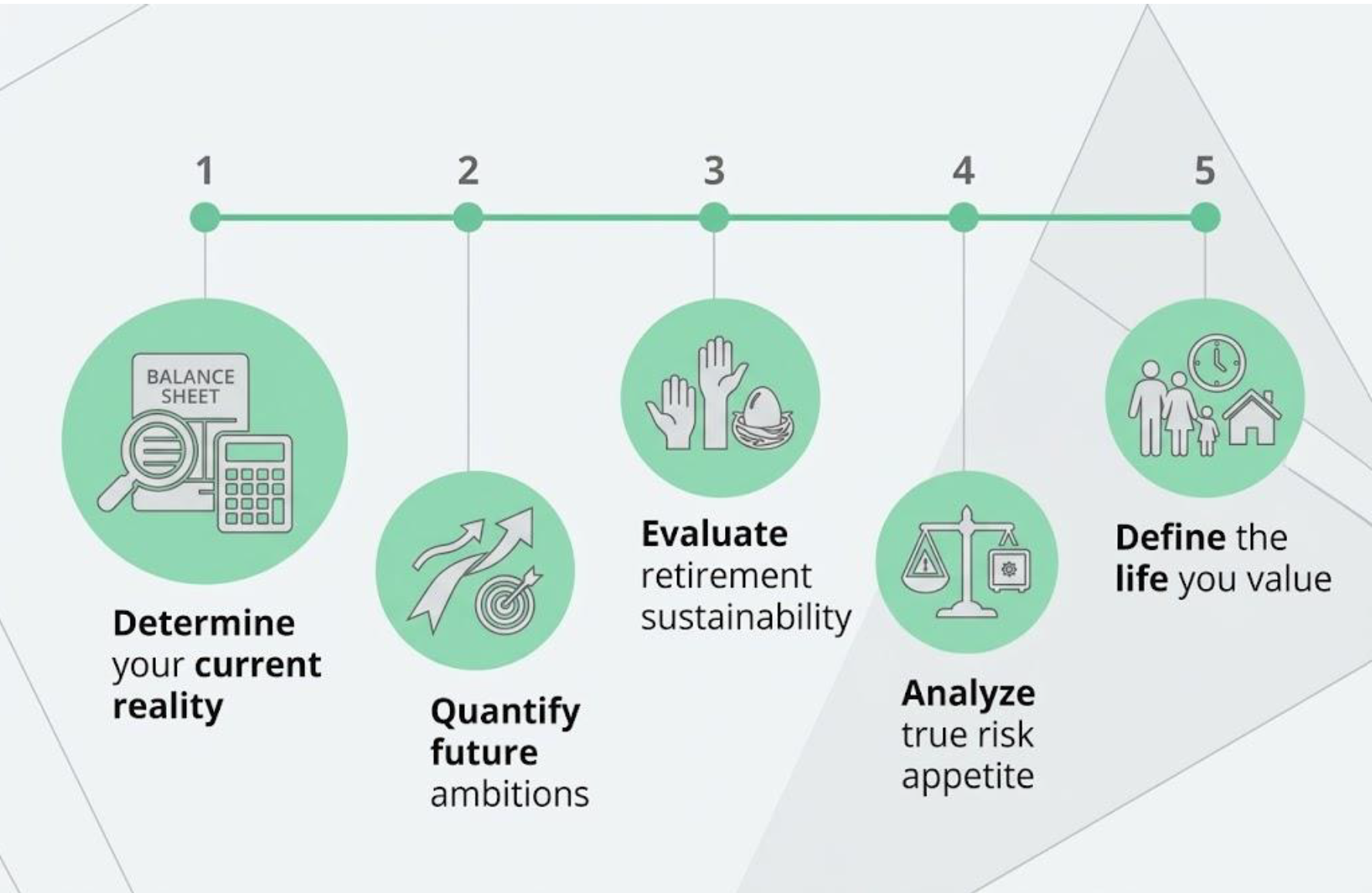
Current reality:
Understanding your immediate balance sheet, tax exposure, cash flows, and obligations.
Future ambitions:
Quantifying your specific goals — whether that means funding a child’s overseas education, expanding a business, or retiring early.
Retirement sustainability:
Calculating what you think you need vs what you actually need to sustain your desired lifestyle long after your primary income stops.
True risk appetite:
Aligning your investment horizon with your emotional comfort zone, so you aren’t forced to sell during market downturns.
The life you value the most:
Ensuring your capital frees up your time to pursue what matters most to you.
When these five elements align, investment decisions stop being speculative guesses. They become intentional choices backed by purpose. And when this happens, an investment portfolio becomes an engine that powers a plan built on your current position, your future goals, and the life you want to live.
Choosing the right financial partner
Because a financial plan touches every area of your life, choosing a financial adviser isn’t about choosing someone to buy stocks for you. It’s about choosing a partner that truly understands your entire financial picture and life vision.
It helps, when evaluating an adviser or firm, to prioritise these four essential pillars:
Pillar 1: Complete context
What to look for
An adviser who asks about your family, business, tax obligations, and estate; not just your investable cash.
Why it matters
Tailored advice is impossible if your adviser only sees a fraction of your net worth.
Pillar 2: Transparent fees
What to look for
A clear breakdown of advisory, platform, and fund manager costs.
Why it matters
Hidden costs compound against your wealth over decades.
Pillar 3: Regular scheduled check-ins
What to look for
Proactive check-ins during market volatility, not just annual updates.
Why it matters
Keeps your strategy disciplined and prevents emotional mistakes during pullbacks.
Pillar 4: Complete Context
What to look for
A team structured to offer objective, conflict-free advice.
Why it matters
Ensures that every single solution serves your long-term roadmap, not short-term targets.
A holistic financial plan protects your most precious asset
At Bovest, we believe money is ultimately a tool designed to purchase your most valuable commodity: time.
You can always earn another Rand, but time spent worrying about market volatility or navigating disjointed financial decisions is lost forever. A sound financial plan gives you the structure, clarity, peace of mind, and freedom to focus on living the life you are building.
From principle to practice: Welvaartskeppers
Season 2 of Welvaartskeppers, our financial TV series on kykNET, premieres on 8 October 2026 (DStvchannel 144). Over thirteen weeks, real entrepreneurs share the thinking and strategies behind building, protecting, and growing what they've earned.
Every conversation has the potential to change a life.
Ready to build your life vision? Share your contact details here and we’ll be in touch — no obligation.